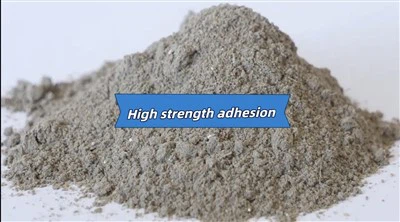


Product Description
The modern plaster mortar is a precisely compounded system. Its typical composition is as follows:
Core Cementitious Material: Building gypsum (hemihydrate gypsum, CaSO₄·0.5H₂O) forms the base. Some high-performance products incorporate small amounts of cement or lime to optimize long-term properties.
Aggregates: Strictly graded quartz sand, river sand, or recycled sand with optimized particle size distribution is used to ensure smooth application and reduce shrinkage cracking.

Functional Additives: These are key to enhancing product performance and include:
Water-retaining Agents: Such as cellulose ethers (HPMC), which prevent water in the mortar from being absorbed too quickly by the substrate, allowing sufficient time for hydration and workability.
Thickeners/Air-entraining Agents: Improve workability and anti-sag properties, and create a uniform micro-porous structure in the hardened mortar, enhancing thermal insulation and reducing weight.
Adhesion Enhancers: Such as redispersible polymer powders (VAE, EVA, etc.), which significantly increase bond strength to various substrates (concrete, blocks, brick walls, insulation boards, etc.) and improve crack resistance.
Retarders: Adjust the setting time to provide a sufficient working window for large-scale batch construction.

Hydrophobic Agents: Used in water-resistant plaster mortar to enhance its resistance to damp environments and moisture transmission.
Fibers: Such as polypropylene fibers, which form a three-dimensional supporting network within the mortar, effectively inhibiting plastic shrinkage and drying shrinkage cracking.

Main Feature
Different base walls and insulation boards such as polystyrene board have strong bonding effects.
● And it has good water resistance, freeze-thaw resistance, and aging resistance.
● Easy to construct, it is a very safe and reliable bonding material for insulation systems.
● During construction, it does not slip or fall, and has excellent weather resistance, impact resistance, and crack prevention performance.
Application Range
Mainly used for bonding insulation boards such as polystyrene board, rock wool board, extruded polystyrene board, and polymer polystyrene board with building interior and exterior walls and ceilings.

Fit Ratio
The ratio of bonding mortar to water is about 4:1 (weight ratio), until mixed evenly. Reference dosage: 6-10kg/m2m2
Technical Performance
|
material |
colour |
shape |
size |
character
|
method of application |
applied range |
|
Cement, quartz sand, polymer binder and other mixtures |
gray |
powder |
About 20 kilograms per bag |
High strength adhesion, waterproof, impermeability, crack resistance, aging resistance |
The ratio of bonding mortar to water: 4:1 (weight ratio) |
It is mainly used for bonding the insulation board with the internal and external walls and ceiling of the building |
Hot Tags: plaster mortar, China plaster mortar manufacturers, suppliers, factory, mortar for jambs, floor mortar, mortar application, green environmental protection mortar, waterproof mortar, repair bonding mortar
Technical specification
Adhesion Strength
After 7 days: ≥ 0.5 MPa
After 28 days: ≥ 1.0 MPa
Enhanced formulations: ≥ 1.5 MPa
Open Time
Standard grade: 20 minutes at 23°C and 50% RH
Extended open time formulations: 30-45 minutes
Flexural Strength
Standard grade: ≥ 3.5 MPa
Flexible grade: ≥ 6.0 MPa
Compressive Strength
28 days: ≥ 10.0 MPa
Pot Life
At 23°C: 4 hours
In hot weather (above 30°C): 2-3 hours
Shrinkage
Drying shrinkage: ≤ 0.15%
Application Temperature
Minimum: +5°C
Maximum: +35°C